

Fleet fuel cards can help a small business spend less on eligible fuel purchases, reduce routine bookkeeping, and give the owner a clearer view of vehicle expenses. The value comes from how well the program fits the business: where employees drive, how much fuel they buy, and how the office handles those purchases.
For a plumbing company, landscaping contractor, delivery service, or other business evaluating vehicle expenses, the useful questions are concrete. Will the card lower the final fuel bill? Can the bookkeeper process transactions faster? Can the owner set purchasing rules and review exceptions without approving every routine fill-up?
Why small-business fuel expenses deserve attention
The Federal Reserve Banks’ 2026 Report on Employer Firms, using the 2025 Small Business Credit Survey, reports that 73% of employer firms faced increased goods, services, or wage costs, 54% faced difficulty paying operating expenses, and 50% experienced uneven cash flow during the prior 12 months. These weighted results come from a nonrandom sample; 6,500 firms answered the financial-challenges question. They describe small employers across industries, not fuel-card customers or measured fuel savings.¹
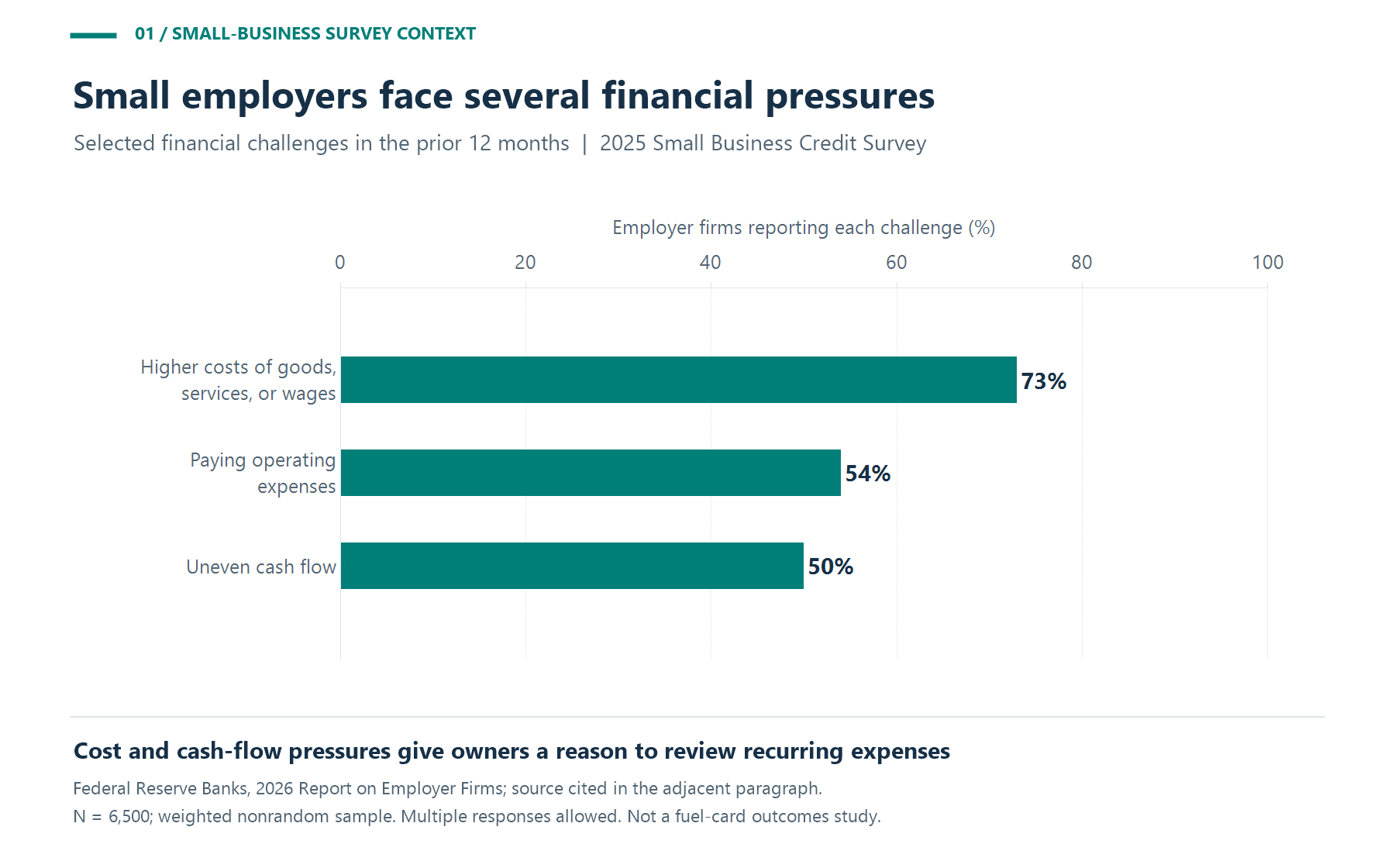
Figure 1. Selected financial challenges from the Federal Reserve report cited above, with 6,500 respondents to this question. These survey findings provide context, not evidence of fuel-card savings.
A practical response is to examine recurring costs and the work required to manage them. Start with the fuel account, then check the administrative process around it. Small improvements are useful when their total value exceeds fees, implementation work, and any additional driving required to use the program.
What a fleet fuel card can offer
Business Fleet Solutions advertises Shell fleet-card options with rebates of up to six cents per gallon, access to more than 12,000 Shell stations or a card option accepted at 95% of U.S. fueling stations, purchase limits, driver IDs, online card management, and fueling reports. These are provider-advertised features across its offerings, not identical terms for every card. Confirm the selected product’s acceptance, rebate eligibility, reporting access, and fees before estimating savings.²
The most useful benefits connect those capabilities to a specific task the business wants to improve.
1. Reduce the net cost of eligible fuel purchases
A fuel rebate creates a measurable benefit when the purchase qualifies and the credit exceeds any extra cost of earning it. Estimate savings using eligible gallons, not every gallon the business buys:
Gross fuel rebate = qualifying gallons × earned rebate per gallon.
For a hypothetical ten-vehicle business buying 20,000 gallons annually, assume 80% qualify for a constant four-cent rebate. The result is $640 per year: 20,000 × 80% × $0.04. Across all gallons purchased, the effective rebate is 3.2 cents per gallon. These are illustrative inputs, not a provider quote.
Compare the final station price as well. In a separate hypothetical purchase, $3.60 per gallon minus a five-cent rebate is $3.55. A suitable station charging $3.50 without that rebate still costs less. On a 20-gallon purchase, the difference is $1.
Request a written fee schedule and a calculation based on the business’s actual fueling locations. Check which purchases qualify, whether rates change with billing-cycle volume, and what existing rewards the business would give up. A card earns its place through the net result after these differences are included.
2. Spend less time organizing and reconciling fuel expenses
Ask the provider to demonstrate the complete workflow: purchase, transaction record, vehicle assignment, accounting export, invoice, and rebate credit. The aim is to reduce repeated handling between the driver, office manager, and bookkeeper.
GSA SmartPay’s fleet guidance describes account-activity reports, exception reports, and detailed electronic transaction files used with financial systems. It says most electronic reports update within two to three days, while some update at the billing-cycle close. This federal-program example illustrates reporting functions and timing differences; it does not establish a commercial provider’s features or update schedule.³
Use a timed pilot to test the proposed process. Suppose the ten-vehicle business handles 120 fuel transactions per month. Reducing average handling time from four minutes to 1.5 minutes would recover:
120 × (4 − 1.5) ÷ 60 = 5 hours per month.
That is 60 hours annually. At an assumed $35 per hour, those hours represent $2,100 in staff-capacity value. Every input is hypothetical; the reduction must be measured in the business’s own workflow.
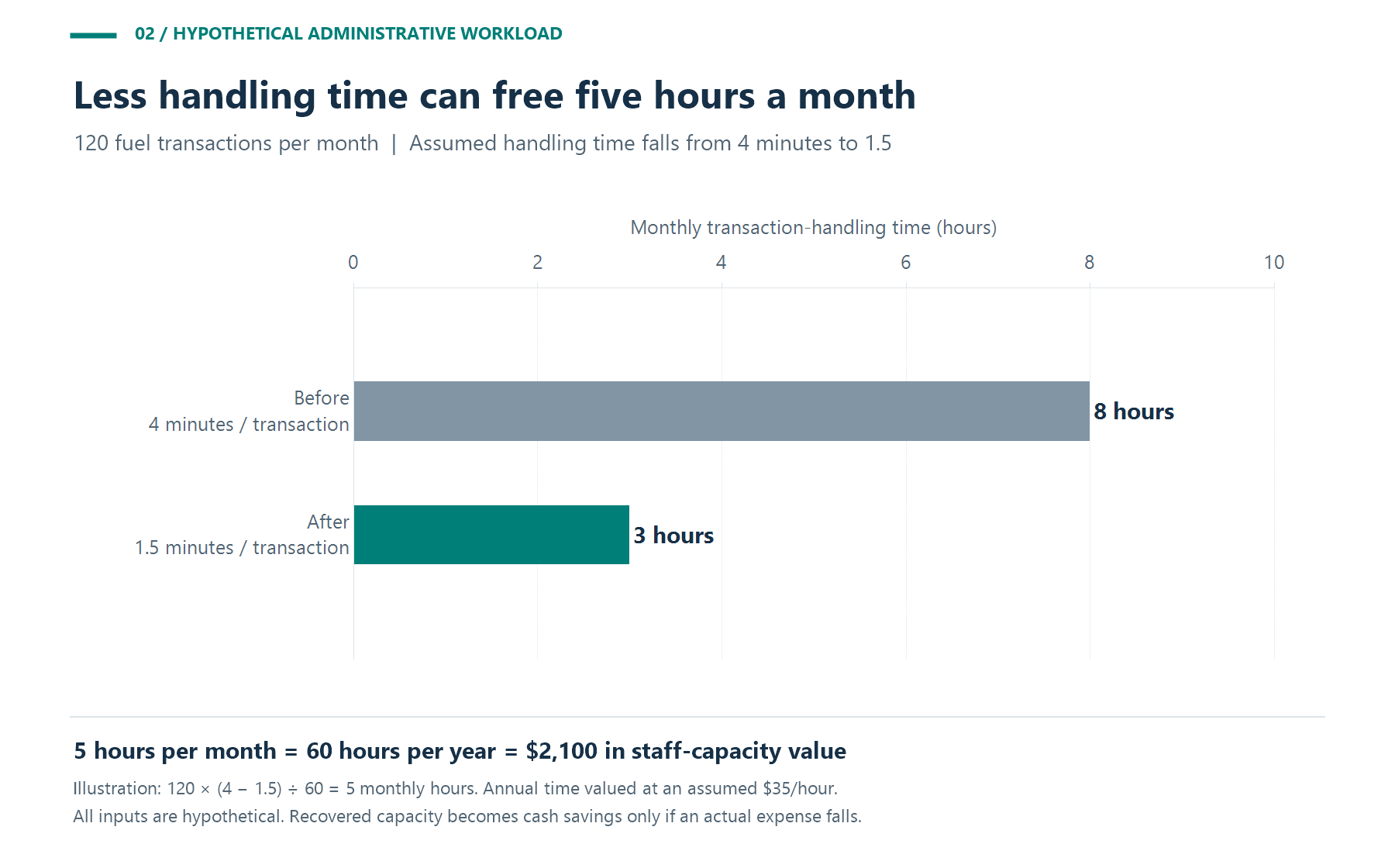
Figure 2. Hypothetical administrative workload. Five recovered hours per month equal 60 per year; the $2,100 value assumes $35 per hour and represents staff capacity.
Recovered time can be reassigned to customer scheduling, collections, or other useful work. It becomes cash savings only if an actual expense falls, such as paid overtime or an outsourced bookkeeping charge. Include remaining corrections and exception handling when timing the process, and avoid counting the same hours as both payroll savings and extra capacity.
3. Set clear purchasing limits and improve accountability
Use the controls demonstrated for the selected program to put the fuel policy into practice. Match available limits to the vehicle’s tank capacity, required fuel, normal schedule, and legitimate emergency needs. Test the settings before drivers depend on them during a workday.
A practical setup gives each authorized user an assigned credential, identifies who manages the account, and records which vehicle or job the purchase belongs to. Make the rules clear to employees, including what to do if an appropriate purchase is declined or a card is lost.
Review unusual transactions with supporting records. A high purchase amount, unexpected location, or weekend fill-up can justify a question; it does not establish misconduct on its own. Record the explanation and resolution, then adjust the rule if it interferes with legitimate work.
Count recovered or prevented spending only when the amount and circumstances are documented. A provider’s control feature is not evidence that a particular business has reduced fraud losses.
4. Build more organized records for the bookkeeper
The IRS says business-expense records should identify the payee, amount, proof of payment, date, and a description showing the business nature of the expense. It lists receipts, account statements, and invoices among supporting documents and notes that several documents may be needed to substantiate an expense. Electronic records remain subject to the same basic recordkeeping principles as paper records.⁴
Use a dedicated fuel-purchasing workflow to make those records easier to gather and match. Connect the transaction to the vehicle, authorized user, and relevant job or business purpose. Retain supporting documentation and give the bookkeeper a consistent export and filing process.
Have the business’s tax preparer identify any additional vehicle-use records needed for its circumstances. A fuel-card statement is one part of the record set; neither using a card nor receiving a report establishes that every charge is deductible.
Test the handoff with a real month of transactions. The useful outcome is a set of records the bookkeeper can reconcile and explain without repeatedly asking drivers to reconstruct purchases.
5. Turn purchase records into better budgets and decisions
The U.S. Department of Energy’s FleetDASH methodology describes a federal fuel-card dataset containing vehicle fuel type, purchased fuel, date, station location, quantity, and organizational assignment. It also documents missing or delayed transactions, miscoded fuels, and incorrect vehicle information. This illustrates both the potential usefulness of fuel records and the need to check their accuracy before acting.⁵
For a small business, start with a short monthly report that answers a few recurring questions:
| Management question | Suggested report | Useful next action |
|---|---|---|
| Where did the fuel budget go? | Gallons and dollars by vehicle or crew | Review changes among comparable assignments |
| Are the expected rebates arriving? | Qualifying volume, expected credits, and posted credits | Resolve a missing or incorrect credit |
| Which stations offer suitable value? | Fuel grade, gallons, net price, and location | Update approved fueling choices |
| Are jobs being costed consistently? | Fuel expense assigned to a documented job or cost center | Check estimates and allocation rules |
| Is the process saving office time? | Handling minutes, corrections, and unresolved items | Remove unnecessary steps or fix the export |
These are recommended report designs, not a claim that every card automatically generates them. Confirm the available fields and exports before committing to a platform.
Use a gallons-weighted average for fuel price: total purchase dollars less relevant credits, divided by gallons. Separate price changes from consumption changes, and compare vehicles doing similar work. A rising fuel bill should prompt a review of prices, activity, and records before it is attributed to driver behavior.
If a decision depends on a driver’s route, use separate verified trip information. A purchase location does not describe the vehicle’s movements between transactions. Resolve missing purchases and incorrect vehicle assignments before relying on a dashboard to evaluate an employee.
6. Give drivers practical fueling options
Evaluate station coverage against the places the business actually works. Map depots, regular customers, service areas, and expected refueling points. Confirm card acceptance, required gasoline or diesel, opening hours, and vehicle access at the specific locations employees would use.
Build an approved-station list that considers the final fuel price and any extra travel. A larger national network is useful only when it improves the business’s practical choices. Acceptance also needs its own check: a station that takes the card may not qualify for the same rebate as another station.
To value driver time, consider a hypothetical eight-minute additional trip. At an assumed $30 per hour, that represents $4 of driver capacity before extra fuel or vehicle costs. Compare that burden with the saving on the intended purchase before directing an employee to a more distant station.
Where the program and company policy allow, arrange authorized business purchases through the company account and define a backup procedure. Test the process with drivers so normal fueling does not require repeated calls to the owner for instructions.
7. Keep fueling organized as the business grows
Build a repeatable process for adding a driver, assigning a vehicle, setting available controls, and explaining approved purchases. Keep one person responsible for the account and assign a backup who can handle an urgent issue.
Use a short onboarding record: authorized driver, vehicle identifier, fuel type, department or job allocation, and purchasing limits. Update that record when vehicles or assignments change, and remove access when it is no longer needed.
Review spending, credits, and unresolved transactions on a regular schedule. Add the expected payment amount and due date to the business’s cash forecast. Include applicable interest and other charges when evaluating payment options; a later payment date should not be counted as a fuel discount.
As more vehicles join the business, test whether reports and account permissions still fit the workload. Expand the program when it preserves a clear purchasing process and someone owns the review work.
What could a ten-vehicle business actually save?
Combine the earlier hypothetical fuel and administrative examples, keeping cash and staff capacity separate. Assume unchanged pump prices, routes, and consumption, and no rewards under the current payment method. Every fee below is illustrative.
| First-year item | Calculation | Annual value |
|---|---|---|
| Fuel rebates | 20,000 gallons × 80% eligibility × $0.04 | $640 |
| Card fees | 10 cards × $2 per month × 12 | −$240 |
| Reporting charges | $10 per month × 12 | −$120 |
| Setup and training | Assumed one-time expense | −$100 |
| Net cash benefit | $640 − $460 | $180 |
| Recovered staff-capacity value | 5 hours per month × 12 × $35 | $2,100 |
| Total economic value | $180 + $2,100 | $2,280 |
The modeled cash benefit is $180, not $2,280. Most of the economic value depends on whether the business recovers the assumed time and uses it productively. No speculative benefit is assigned to fraud prevention, reporting decisions, or station coverage.
The fuel-only break-even rate is 2.875 cents per eligible gallon: $460 divided by 16,000 qualifying gallons. At a two-cent rate, rebates fall to $320 and the first-year cash result becomes negative $140.
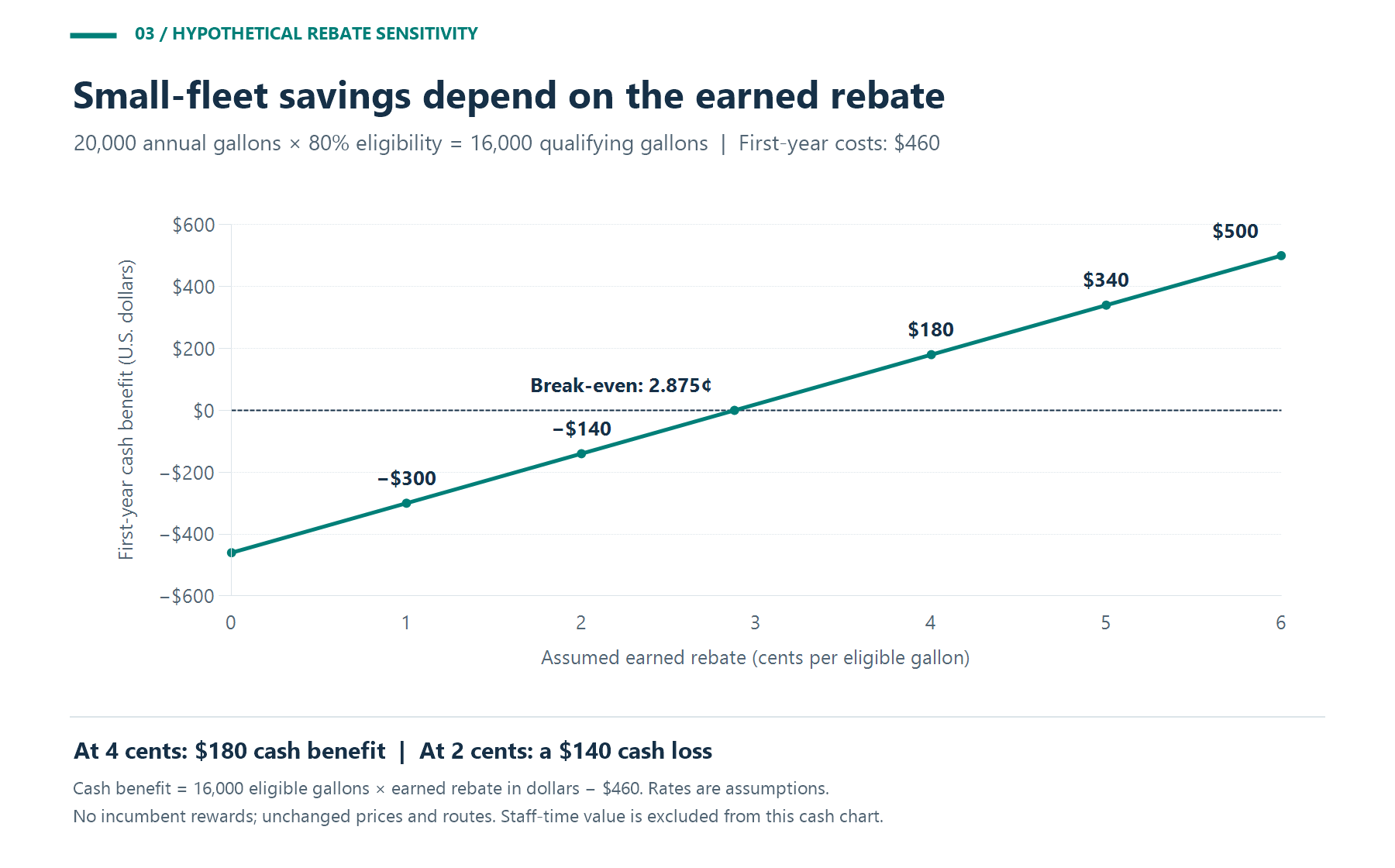
Figure 3. Hypothetical rebate-rate sensitivity with 16,000 eligible annual gallons and $460 in first-year costs. Constant rates are assumed; staff-capacity value is excluded.
Before choosing a card, replace the assumptions with a quote and a representative purchase history. Deduct existing rewards, include every incremental charge, and calculate billing-cycle tiers separately where required. Measure administrative effort over the complete process.
A fleet fuel card benefits a small business when it produces a lower net cost, useful recovered time, or clearer control that justifies the work and expense. Start with the business’s actual vehicles and purchasing habits, then select the program whose results the owner and bookkeeper can verify.